2025 Review
Written on
This is my first annual review. Credit to Will Larson's practice of doing this as my inspiration for doing the same. Thanks Will!
This year started out with being declined on my application to University of Michigan which led me to explore a whole bunch of different things from continuing research, career change and starting my own company. I turned 50 this year so it's a bit of a milestone for me and as I write this I expect to have a little under 12,000 days to complete my life goals. Middle age has been a rewarding and growing experience for me. It's changed my perspective a lot and I find myself counting backwards from the end of things as I plan for the future now.
Doctor of Engineering
Due to what I believe were complications and uncertainty about foreign students in the US I had to apply twice but thankfully on my second application I was accepted to University of Michigan-Dearborn Electrical and Computer Engineering Doctor of Engineering program. I officially start next week. This is a 3 year program so I should be on track to obtain my D.Eng by late 2028 or early 2029.
For my research I was initially pursuing methods to seamlessly connect patient records and make the full medical record easily available to both the patient and clinicians. I researched multiple privacy-protecting protocols, methods for doing things like record interventions on a blockchain to tie multiple EMR systems togeather. This path sent me deep into distributed systems, protocols and "web 3.0". There's some really good work out there in re-architecting the internet to be more distributed in the interest of protecting privacy and decentralizing control of major services. The W3C Decentralized Identifier Working Group has published some amazing standards on Decentralized Identifiers (DIDs) and DID Document Property Extensions. I had heard about the Solid Project many years ago and it seemed to show promise but I'm a little confused as to their direction now. In the end the conclusion I came to was the most effective way to centralize the patient record would be to build a zero knowledge electronic medical record that the patient controls themselves. Think of 1password for your medical records. This was the path I was going to go down but I became increasingly discouraged that the slow pace of health systems combined with huge EMR vendors would make this path impossible even if the technology existed tomorrow. I want to work on something that I can see used in production and see real benefits to patients or healthcare organizations before the end of my career and I felt I would get mired down in politics and organizational inertia with this work.
In parallel to that research I was learning about LLMs, the various branches of AI and how things evolved into where we are today. This is where I came across reinforcement learning (RL), Richard Sutton's work and The Alberta Plan for AI Research. Reinforcement learning focuses on computer learning modeled after animal learning. It crosses computer learning methods, psychology and neuroscience with an ultimate goal of Artificial General Intelligence (AGI). This brought me back to some of my interests when I was an undergrad and aspired to be a psychiatrist. The prospect of implementing animal learning functions in computers really resonates with me so I dove deep into this topic and will be making it the focus of my research. I did spent 12 weeks on deep learning and then multiple, iterations of a reinforcement learning roadmap with a 2 month sprint to prepare to start the D.Eng. I designed and started a few different implementation projects for an AI project but never saw anything to completion as I kept focusing on learning, research and brushing up on the math required since I was so out of practice. I still have a lot of research to do on the foundations of RL and recent progress so this will be the focus for the next year and become my literature review. I'm still searching for an application of RL that I can work on which will line up with the Alberta Plan but I'm hoping to find something healthcare related that can contribute to solving issues within digital healthcare.
Writing
I made some progress on this front but didn't get to the level of consistency or quality I was hoping to. I will have to continue to focus on this in 2026. I did write 11 blog postings, although I don't really consider the learning roadmaps the type of writing I was striving for so that translates into a handful of actual blog postings. I got an opinion piece titled 'Secure email’: A losing battle CISOs must give up published in CSO Online. I was happy with that work and the experience of working with the editor at CSO Online so I think continuing to pursue those types of opportunities makes sense. It's yet to be seen how much time I will have for writing outside of the doctoral work though so I expect my blog postings will be aligned with my research and hopefully I'll find the time for some other publications along the way.
Coding
All of the Coursera courses I took this year had labs in Jupyter notebooks so I was able to work through a bunch of hands on examples to learn NumPy, PyTorch and TensorFlow. In addition to that I worked a lot with coding agents this year both experimenting and solving problems. The AI agents have been a great tool to turbo charge learning new languages, frameworks and libraries. They've enabled me to rapidly build on antiquated skillets (e.g. Perl/Apache/mod_perl) and learn new, modern equivalents. I guess I'm what would be classified as a "full stack" developer and work with Python, FastAPI, Django, NumPy, PyTorch etc now. I'm really interested in exploring HTMX for front end work but haven't got around to it yet.
I spent a lot of time getting up to speed on CICD using gitlab as my platform for this automating build, test and deployment into Docker containers on Debian hosts. All of this has re-kindled my love of git and I'm on a constant mission to solve problems with git, gitlab and CICD. Git is just pure elegant genius and I'm still amazed that Linus wrote it over a short period of time to solve such a massive problem and came up with the most advanced version control system in existence. Side note I'm an enormous Linus Torvalds fan and feel he has single handedly contributed more to society than any other software engineer in history.
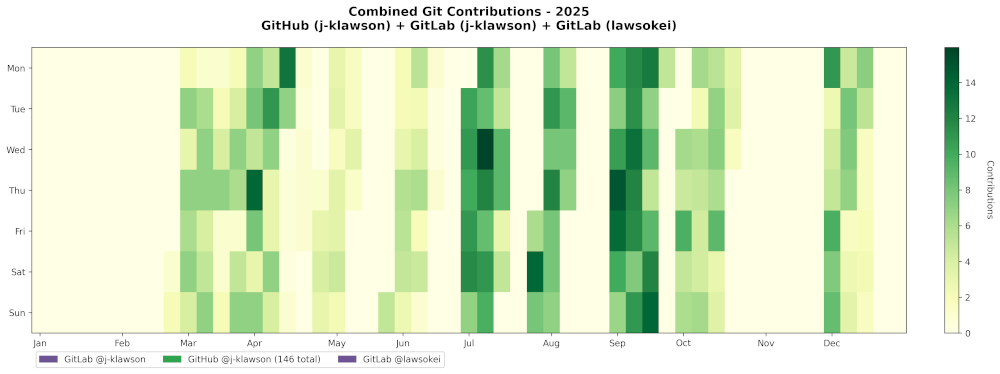
Here's Claude's estimated visualization of my combined personal gitlab, work gitlab and github contributions in 2025:
Leadership Development
I read a lot on the path to executive positions and worked with an executive coach this year on what that looks like. Most of my work here was through reading and taking advantage of opportunities at work to network with other leaders so that I can learn from them. Leadership development is just going to be a lifelong task of continual improvement and I do still aspire to pursue VP level positions.
Public speaking
I only spoke at two events this year but it did give me an opportunity to prepare new content, speak on something different and practice in front of audiences. We hosted the Health-ISAC Canadian event this year where I spoke on the Identity and Access Management (IAM) and how IAM is rapidly becoming our primary security concern. I also chaired a track at the Cyber Security For Critical Assets conference.
Reading
For obvious reasons a lot of my reading time was spent reading research papers but I didn't keep a log of them to post here. I read the following books for professional and personal development this year.
The Obstacle Is The Way - Ryan Holiday
The Internet Con - Cory Doctorow
A Hackers Mind - Bruce Schneier
The Engineering Executive's Primer: Impactful Technical Leadership - Will Larson
The Phoenix Project: A Novel about IT, DevOps, and Helping Your Business Win
Flow: The Psychology of Optimal Experience
Solving Identity Management in Modern Applications: Demystifying OAuth 2, OpenID Connect, and SAML 2